Bandeira Nacional da Irlanda
The Meaning of the Tricolour


Together the colours express inclusion and reconciliation, the central message behind the flag.
FROM WATERFORD TO A NATIONAL SYMBOL

FROM WATERFORD TO A NATIONAL SYMBOL
THE STORY OF THE IRISH FLAG
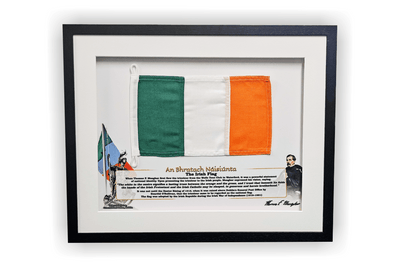
The Irish tricolour brings together a message of peace and the story of a nation’s independence. From its association with Thomas Francis Meagher in 1848 to its recognition in the Constitution, it became an enduring symbol of Ireland.
1848 — Thomas Francis Meagher
Meagher helped establish the tricolour as a symbol of unity between Irish Catholics and Protestants. In April 1848, he presented a silk tricolour brought from France to a gathering in Dublin, explaining that the white represented a lasting truce between orange and green.
1916 — The Easter Rising
The tricolour flew above Dublin’s GPO during the Easter Rising, alongside a green flag bearing the words “Irish Republic”. After the Rising, it became increasingly associated with the movement for Irish independence and gained wider recognition as a national symbol
1922 — The Irish Free State
With the establishment of the Irish Free State in 1922, the tricolour was adopted as its flag. The green, white and orange now represented the new State, carrying forward the aspiration for unity between Ireland’s different traditions.
1937 — Our National Flag
The Constitution of Ireland formally confirmed the tricolour’s status in 1937. Article 7 states: “The national flag is the tricolour of green, white and orange.” Today, it remains a symbol of national identity, belonging and the hope for a shared future.
HOW TO FLY THE IRISH FLAG

GREEN NEAREST THE POLE
Fly the flag with the green panel nearest the flagpole, white in the centre and orange at the outer edge. Keep it clear of the ground and nearby obstacles.

ALONGSIDE OTHER NATIONAL FLAGS
Use separate flagpoles of equal height and flags of equal width. The Irish flag should occupy the position of honour, normally on the viewer’s left in a straight line of flags.

FLYING AT HALF-MAST
First raise the flag to the top of the pole, then lower it to the half-mast position. Before taking it down, raise it to the top once more.
More about displaying your flag
When displayed horizontally, green should be on the viewer’s left. When hung vertically, green should be uppermost.
The flag may remain flying after dark if it is properly illuminated throughout the night, preferably by a spotlight.
Keep the flag clear of the ground, water and nearby obstacles when raising or lowering it.
A worn or frayed flag should be taken out of display and disposed of in a dignified way.
CARING FOR YOUR IRISH FLAG

TAKE DOWN IN SEVERE WEATHER
Strong winds put extra strain on the fabric, seams and fittings. Take your flag down before storms or severe weather.

WASH AT 30°C
Wash gently using a mild detergent, following the care instructions supplied with your flag. Avoid bleach and harsh cleaning products.
DRY BEFORE STORING
Allow your flag to dry fully before folding it away. Store in a clean, dry place to help prevent mildew and musty odours.

About the Thomas F. Meagher Foundation
The Thomas F. Meagher Foundation helps young people discover the history of the Irish flag and its message of peace, unity and inclusion.
Through its schools programme, Flag Day, awards and scholarships, the Foundation encourages active citizenship and a sense of belonging. Schools celebrate the Irish tricolour alongside the national flags of their students, recognising the different backgrounds that make up their community.

AN IRISH FLAG, MADE IN IRELAND

AN IRISH FLAG, MADE IN IRELAND
Manufactured in the heart of Dublin
We’ve been making flags in Dublin since the 1950s. Today, our family-run team continues that tradition in our Montague Lane factory, cutting, sewing and finishing Irish flags for homes, schools, businesses and public buildings.
Three colours. Individually sewn.
Our premium woven tricolours are made from separate green, white and orange panels, joined together using 155gsm woven polyester.
Finished for your display.
Each flag is hemmed and fitted with your chosen attachment, ready for the way you intend to fly or display it.
FURTHER IRISH FLAGS PRODUCTS